
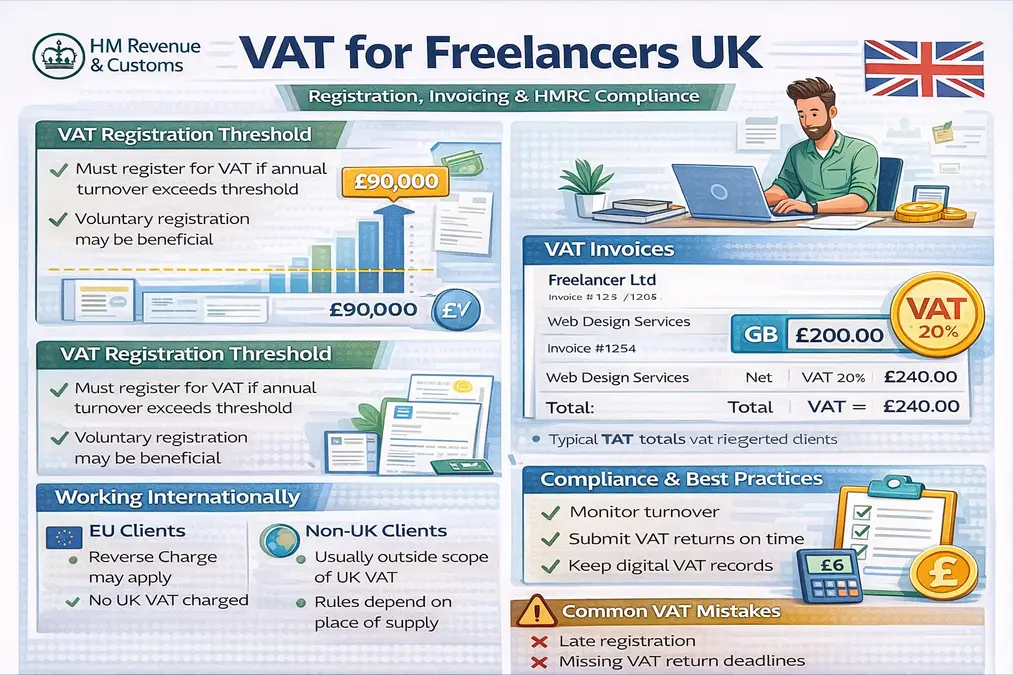
Freelancers in the UK often operate as sole traders or limited companies providing services to clients. Understanding VAT for freelancers UK is essential when your business turnover approaches the VAT registration threshold or when working with international clients.
Once registered for VAT with HM Revenue & Customs, freelancers must charge VAT on taxable services, submit VAT returns under Making Tax Digital, and maintain accurate VAT records.
This guide explains when freelancers must register for VAT, how VAT invoices work, how to handle cross-border services, and common VAT compliance mistakes.
- Do Freelancers Need to Register for VAT in the UK?
- How VAT Works for Freelancers
- VAT Rates Applied to Freelance Services
- How Freelancers Must Issue VAT Invoices
- VAT Returns for Freelancers
- VAT for Freelancers Working With International Clients
- VAT Accounting Schemes Available to Freelancers
- Common VAT Mistakes Made by Freelancers
- Best Practices for Freelance VAT Compliance
- Frequently Asked Questions
- Conclusion
Do Freelancers Need to Register for VAT in the UK?
Freelancers must register for VAT if their taxable turnover exceeds the VAT registration threshold set by HMRC.
The threshold applies to the total value of taxable sales over a rolling 12-month period.
You can learn more in our guide on the UK VAT registration threshold.
Voluntary VAT Registration
Freelancers may also choose to register voluntarily, even if their turnover is below the threshold.
Possible reasons include:
- Claiming input VAT on business expenses
- Working with VAT-registered clients
- Improving business credibility
However, once registered, freelancers must comply with all VAT obligations.
How VAT Works for Freelancers
VAT operates as a tax collected on behalf of HMRC.
Freelancers must charge VAT on taxable services and submit the VAT collected to HMRC after deducting VAT paid on business expenses.
Key concepts include:
| Term | Meaning |
|---|---|
| Output VAT | VAT charged to clients |
| Input VAT | VAT paid on business purchases |
| Net VAT payable | Output VAT minus Input VAT |
Understanding these calculations is explained in how VAT works.
VAT Rates Applied to Freelance Services
Most freelance services in the UK are subject to the standard VAT rate of 20%.
Typical taxable freelance services include:
- Marketing and consulting
- Graphic design
- IT services
- Copywriting
- Web development
For a full explanation, see UK VAT rates.
How Freelancers Must Issue VAT Invoices
Once VAT-registered, freelancers must issue VAT-compliant invoices.
A VAT invoice must include:
- Business name and address
- VAT registration number
- Invoice number
- Date of supply
- Description of services
- Net price
- VAT rate applied
- VAT amount charged
- Total amount payable
Understanding the difference between pricing structures is explained in VAT inclusive vs exclusive pricing.
VAT Returns for Freelancers
Freelancers registered for VAT must submit VAT returns to HMRC.
Most freelancers submit returns quarterly.
A VAT return normally includes:
- Total sales and output VAT
- Total purchases and input VAT
- Net VAT payable or refundable
Returns must be submitted electronically under Making Tax Digital (MTD).
More information is available in UK VAT return basics.
VAT for Freelancers Working With International Clients
Freelancers often work with overseas clients, which can affect VAT treatment.
Services to EU Businesses
If services are supplied to VAT-registered EU businesses:
- VAT may not be charged
- The reverse charge mechanism may apply
Services to Non-UK Clients
For many services supplied to businesses outside the UK:
- The supply may be outside the scope of UK VAT
- VAT may not be charged
However, rules vary depending on the place of supply.
VAT Accounting Schemes Available to Freelancers
HMRC provides several VAT accounting schemes designed for smaller businesses and freelancers.
Common options include:
Flat Rate Scheme
Freelancers pay VAT at a fixed percentage of turnover rather than calculating VAT on each transaction.
Official HMRC guidance:
https://www.gov.uk/vat-flat-rate-scheme
Cash Accounting Scheme
VAT is paid when customers actually pay invoices, not when invoices are issued.
Annual Accounting Scheme
Freelancers submit one VAT return per year with advance payments.
More information is available in UK VAT accounting schemes.
Common VAT Mistakes Made by Freelancers
HMRC compliance checks frequently identify errors such as:
- Registering for VAT too late
- Charging VAT incorrectly on overseas services
- Issuing invoices without VAT numbers
- Incorrect VAT calculations
- Missing VAT return deadlines
You can review additional examples in common UK VAT mistakes.
Best Practices for Freelance VAT Compliance
Freelancers should adopt several best practices to remain compliant:
- Monitor turnover regularly
- Register for VAT when required
- Issue VAT-compliant invoices
- Maintain digital VAT records under MTD
- Submit VAT returns on time
Many freelancers verify calculations using tools such as the UK VAT calculator.
Frequently Asked Questions
Do freelancers have to register for VAT in the UK?
Freelancers must register if their taxable turnover exceeds the VAT registration threshold within a 12-month period.
Can freelancers register for VAT voluntarily?
Yes. Freelancers can voluntarily register even if their turnover is below the threshold.
Do freelancers charge VAT to international clients?
In many cases, VAT is not charged to overseas business clients due to reverse charge or place-of-supply rules.
What VAT rate do freelancers charge?
Most freelance services are subject to the standard VAT rate of 20%.
Do freelancers need to submit VAT returns?
Yes. VAT-registered freelancers must submit VAT returns to HMRC, usually every quarter.
Conclusion
Understanding VAT for freelancers UK is essential for maintaining compliance with HMRC regulations. Once registered for VAT, freelancers must charge VAT correctly, issue compliant invoices, and submit VAT returns under Making Tax Digital rules.
By monitoring turnover, understanding cross-border VAT rules, and maintaining accurate digital records, freelancers can manage VAT obligations effectively while avoiding penalties.