
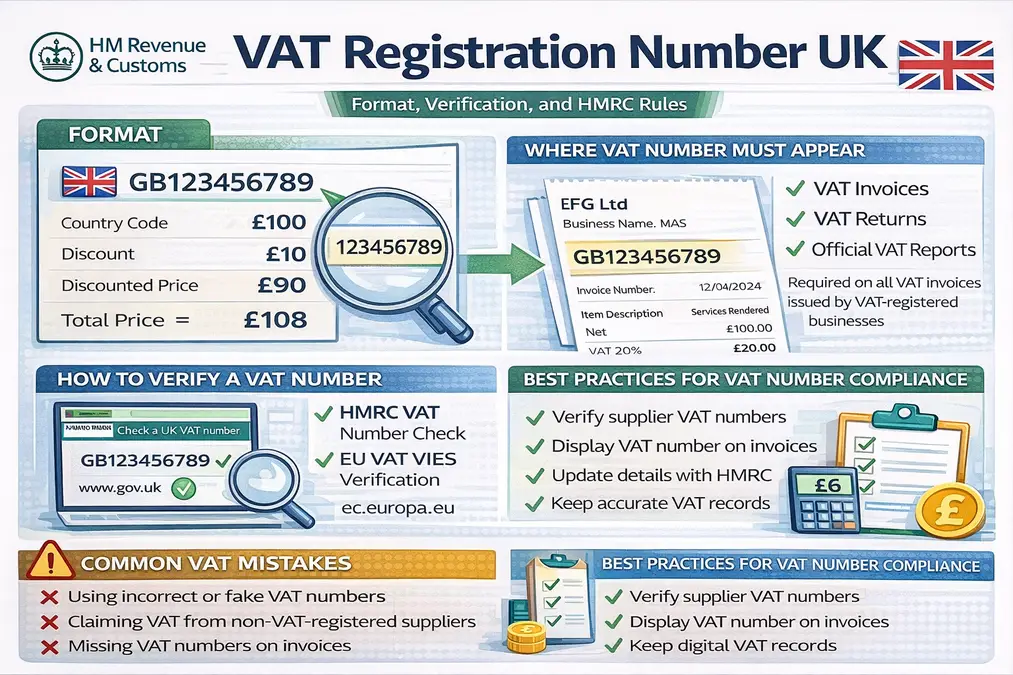
A VAT registration number UK is a unique identifier issued to businesses registered for Value Added Tax by HM Revenue & Customs (HMRC). Businesses must include this number on VAT invoices, VAT returns, and official tax records.
The VAT registration number allows HMRC to track VAT collected and paid by businesses and ensures that VAT is correctly reported through the UK tax system.
This guide explains the VAT registration number UK format, where it must appear on invoices, how to verify it, and how it affects domestic and cross-border VAT transactions.
What Is a VAT Registration Number UK?
A VAT registration number UK is issued when a business registers for VAT with HMRC. Once registered, the business becomes responsible for:
- Charging VAT on taxable supplies
- Submitting VAT returns
- Paying VAT owed to HMRC
- Keeping VAT records
Businesses must register if their taxable turnover exceeds the VAT threshold.
You can read more in our guide on the UK VAT registration threshold.
VAT Registration Number UK Format
A standard UK VAT number usually follows this format:
GB123456789
Structure:
| Component | Meaning |
|---|---|
| GB | United Kingdom country code |
| 123456789 | Unique 9-digit VAT number |
In some cases, businesses may have additional digits for special VAT schemes.
Examples:
- GB123456789
- GB123456789000
When Businesses Must Register for VAT
A business must register for VAT if:
- Taxable turnover exceeds the VAT registration threshold
- It expects turnover to exceed the threshold within 30 days
- It sells goods to the UK from overseas under certain rules
Current threshold information is explained in UK VAT registration threshold.
Businesses may also register voluntarily, even if turnover is below the threshold.
Where the VAT Registration Number Must Appear
HMRC requires the VAT registration number UK to appear on official VAT invoices.
A VAT invoice must normally include:
- Business name and address
- VAT registration number
- Invoice number
- Date of supply
- Description of goods or services
- VAT rate applied
- VAT amount charged
Understanding how VAT appears on invoices is explained in VAT inclusive vs exclusive pricing.
How to Verify a VAT Registration Number UK
Businesses often verify VAT numbers to confirm that a supplier is legitimately VAT-registered.
Verification helps prevent VAT fraud and incorrect VAT claims.
Methods include:
1. HMRC VAT Number Check
Businesses can check VAT numbers through HMRC’s verification services.
Official source:
VAT Registration Check
2. EU VAT Information Exchange System (VIES)
When dealing with EU businesses, VAT numbers can be verified using the **European Commission VAT Information Exchange System.
Official service:
https://ec.europa.eu/taxation_customs/vies/
VAT Registration Number and Reverse Charge
The reverse charge mechanism requires both the supplier and customer VAT numbers for certain transactions.
Common scenarios include:
- Services purchased from overseas suppliers
- Construction industry reverse charge
In these cases, the VAT registration number confirms that the customer is responsible for accounting for VAT.
Cross-Border VAT and VAT Numbers
VAT numbers are especially important for international transactions.
EU Business Transactions
VAT numbers determine whether VAT should be:
- Charged normally
- Zero-rated for exports
- Accounted for under reverse charge
Imports and Exports
VAT numbers may be required for:
- Import VAT accounting
- Customs documentation
- VAT reporting for international sales
What Happens After VAT Registration
Once a business receives a VAT registration number UK, it must:
- Charge VAT on taxable supplies
- Issue VAT-compliant invoices
- Maintain digital VAT records
- Submit VAT returns under Making Tax Digital
You can read more in our guide to UK VAT return basics.
Common Mistakes With VAT Numbers
HMRC compliance checks often identify mistakes such as:
- Using an incorrect VAT number on invoices
- Claiming VAT from non-VAT-registered suppliers
- Failing to verify overseas VAT numbers
- Omitting VAT numbers on invoices
More examples are explained in common UK VAT mistakes.
Best Practices for VAT Number Compliance
Businesses should follow these practices:
- Verify supplier VAT numbers before claiming input VAT
- Display VAT number on all VAT invoices
- Keep digital records under MTD rules
- Update VAT details when business information changes
These steps help maintain compliance with HMRC regulations.
Frequently Asked Questions
What does a VAT registration number UK look like?
Most UK VAT numbers follow the format GB followed by nine digits, such as GB123456789.
Is a VAT registration number the same as a company number?
No. A VAT number is issued by HMRC for VAT purposes, while a company number is issued by Companies House.
Can I verify a VAT registration number?
Yes. VAT numbers can be checked through HMRC’s online VAT verification service.
Do all businesses have VAT numbers?
No. Only businesses that register for VAT receive a VAT registration number.
Can a business register voluntarily for VAT?
Yes. Businesses may voluntarily register even if turnover is below the VAT registration threshold.
Conclusion
A VAT registration number UK is a key identifier for businesses registered with HMRC. It ensures that VAT charged on sales and claimed on purchases can be accurately tracked through the VAT system.
Understanding how VAT numbers work, where they must appear on invoices, and how to verify them helps businesses remain compliant with HMRC regulations while avoiding VAT errors and fraud risks.