Quick answer: A VAT control account is a ledger account that adds up the VAT you charge on sales (output VAT) and the VAT you pay on purchases (input VAT). Its balance should equal the net VAT you owe HMRC, or are owed, on your VAT return.
What is a VAT control account?
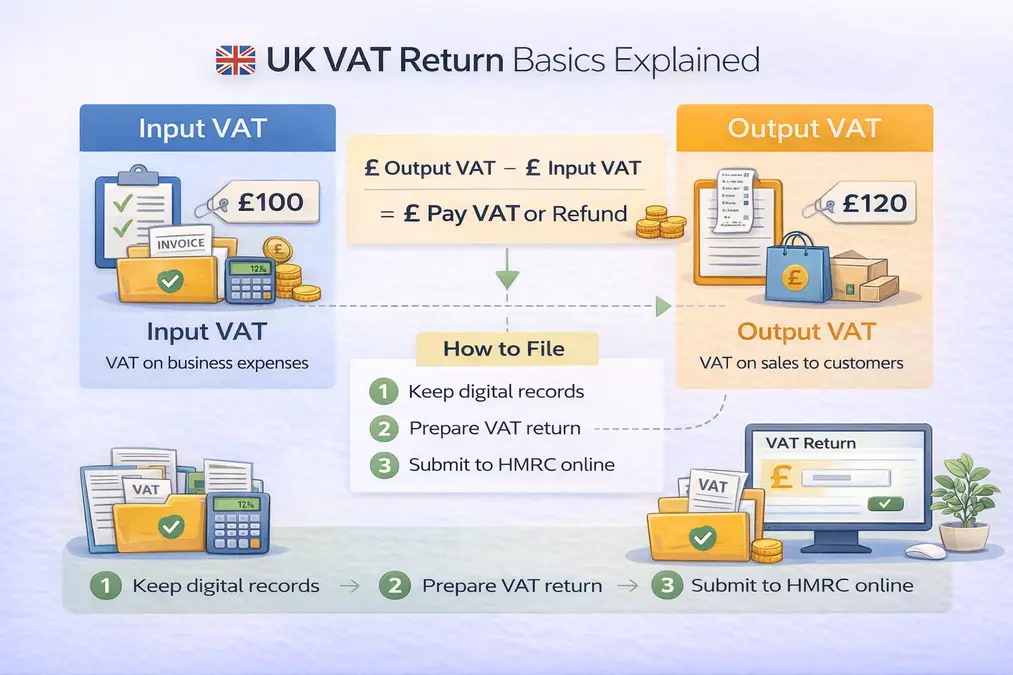
This nominal ledger account sits in your bookkeeping, not at a bank. It collects VAT charged on sales and VAT paid on purchases so you can see how much you owe HMRC at any time.
How the VAT control account works
- Credit: VAT charged on sales (output VAT).
- Debit: VAT paid on purchases and expenses (input VAT).
- Credit balance: you owe HMRC. Debit balance: HMRC owes you a refund.
Example: sales of £10,000 + £2,000 VAT and purchases of £4,000 + £800 VAT. Output VAT of £2,000 less input VAT of £800 leaves £1,200 to pay. That figure is box 5 of the return. The calculations behind a return are explained in UK VAT return basics.
How to reconcile a VAT control account
- Run the ledger report for the return period.
- Compare the closing balance to box 5 (net VAT due) on the return.
- Investigate any difference before you file.
After you pay HMRC, the balance should be close to zero. A balance that keeps growing usually means a payment or an adjustment was not recorded.
Why your VAT control account may not match the return
- Timing: invoices dated in one period but paid in another, especially under cash accounting or the flat rate scheme (see VAT accounting schemes).
- Manual journals posted straight to the VAT account.
- Rounding differences (see VAT rounding rules).
- Bad debt relief, fuel scale charges or partial exemption adjustments.
- Payments to HMRC posted to the wrong account.
Keeping the VAT control account accurate
Post VAT through normal sales and purchase transactions, avoid manual journals, and reconcile after every return. Filing rules and deadlines are on GOV.UK. To check an amount use the UK VAT calculator.
Common questions
Is a VAT control account a real bank account?
No. It is a ledger account in your accounting software or books.
Should the balance be zero?
Only after the VAT for that period has been paid or received. Before then it equals the VAT due.