
Introduction
Value Added Tax (VAT) is one of the most common taxes applied to goods and services in the United Kingdom. Whether you are shopping as a consumer or running a business, VAT affects prices, invoices, and payments every day.
This guide explains UK VAT in simple terms, including how it works, current VAT rates, and how VAT is calculated in practice. Understanding the basics of UK VAT helps you read prices correctly, avoid calculation mistakes, and know when VAT applies.
Table of Contents
- What Is VAT in the UK?
- How UK VAT Works
- UK VAT Rates Explained
- UK VAT Calculation Example
- When Do You Charge VAT in the UK?
- UK VAT Registration Threshold
- Calculate UK VAT Online
- External Reference
- Frequently Asked Questions
- Key Takeaways
What Is VAT in the UK?
UK VAT is a consumption tax charged on most goods and services sold in the UK. It is added to the price at each stage of production or sale, but the final cost is paid by the consumer.
Businesses collect VAT on behalf of HMRC and pass it on after deducting any VAT they have paid on their own purchases.
Learn VAT basics first: VAT Meaning
How UK VAT Works
The UK VAT system follows a simple flow:
- A business sells goods or services
- VAT is added to the price
- The customer pays the total amount
- The business sends VAT to HMRC
Businesses only pay VAT on the value they add, not on the full selling price.
Full explanation: VAT system overview
UK VAT Rates Explained
The UK currently uses three main VAT rates:
- Standard rate: 20%
- Reduced rate: 5%
- Zero rate: 0%
Different goods and services fall under different rates depending on UK tax rules.
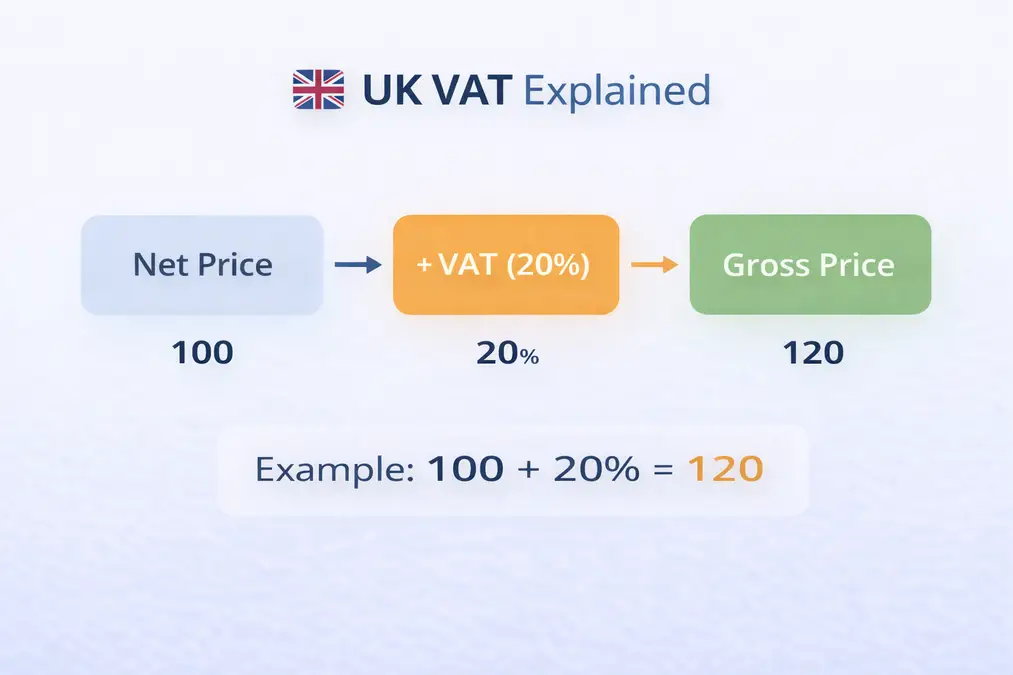
UK VAT Calculation Example
Example (Standard Rate):
- Net price: 100
- VAT rate: 20%
- VAT amount: 20
- Gross price: 120
Formula:
Gross price = Net price × (1 + VAT rate)
Learn the full formula: VAT calculation method
When Do You Charge VAT in the UK?
You usually charge VAT if:
- Your business is VAT registered
- The goods or services are VAT taxable
- The place of supply is the UK
If you are not VAT registered, VAT is not added.
UK VAT Registration Threshold
Businesses must register for VAT when taxable turnover exceeds the UK VAT threshold set by HMRC. Some businesses choose voluntary registration even below the threshold.
Detailed guide coming next in the UK silo.
Calculate UK VAT Online
To avoid manual errors, you can use a dedicated UK VAT calculator.
Calculator link: how to calculate VAT UK
External Reference
For official UK VAT rules and guidance, see:
HMRC – VAT Guidance
Frequently Asked Questions
What is the standard VAT rate in the UK?
The standard VAT rate in the UK is 20%.
Do all goods and services have VAT?
No. Some are reduced-rated or zero-rated.
Who pays VAT in the UK?
Consumers pay VAT; businesses collect and report it.
Key Takeaways
- UK VAT is a consumption tax
- Standard VAT rate is 20%
- VAT is added to most goods and services
- Businesses collect VAT for HMRC
- Calculators reduce errors