
How VAT Works Explained: Simple Steps with Real Examples
Introduction
Value Added Tax (VAT) works by taxing the value added to goods and services at each stage of production or sale.
Instead of being charged only once at the final point of sale, VAT is collected in small portions as products move through businesses before reaching the final customer.
This article explains how VAT works step by step, who charges it, who ultimately pays it, and how VAT is reported. Because VAT rates and rules vary by country, understanding this process helps you calculate VAT accurately in places like the UK, UAE, Saudi Arabia and Qatar.
Table of Contents
- How VAT Works
- Why VAT Is Charged at Every Stage
- How VAT Works for Customers
- Does VAT Work the Same in Every Country?
- External Reference
- Key Takeaways
- Frequently Asked Question
How VAT Works
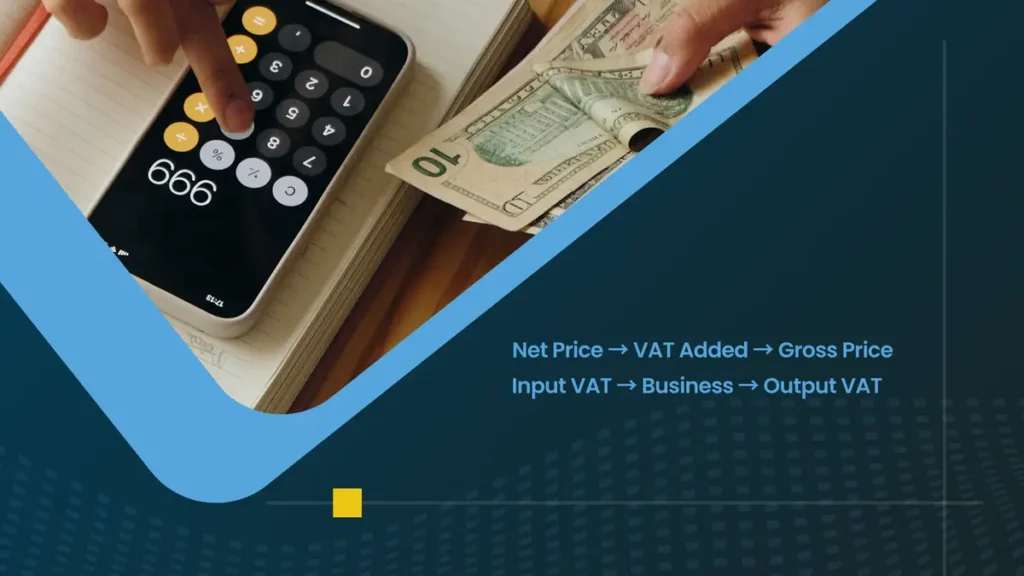
At a basic level, VAT follows this flow:
- A business sells goods or services
- VAT is added to the selling price
- The customer pays the total amount
- The business passes the VAT portion to the government
Even though VAT appears multiple times in the supply chain, only the final consumer bears the cost.
1: Buying Goods or Services
When a VAT-registered business buys goods or services, it usually pays VAT on that purchase.
This VAT is known as input VAT.
Example:
- Purchase price: 100
- VAT rate: 20%
- VAT paid: 20
- Total paid: 120
In most cases, businesses can reclaim this VAT later.
For a refresher on the basics, see
What Is VAT? A Simple Explanation for Beginners
2: Adding Value to the Product or Service
The business then:
- Uses materials
- Adds labor or expertise
- Improves or resells the product
This improvement is the “value added”, which is the core idea behind VAT.
3: Selling to Customers (Output VAT)
When the business sells the product or service, it charges VAT to the customer.
This VAT is called output VAT.
Example:
- Net selling price: 200
- VAT at 20%: 40
- Total charged to customer: 240
The customer pays VAT as part of the final price.
4: Paying VAT to the Government
At the end of a reporting period, the business calculates:
VAT payable = Output VAT − Input VAT
- If output VAT is higher → VAT is paid to the government
- If input VAT is higher → a refund may be due
This system ensures businesses are taxed only on the value they add, not the full sale price.
Why VAT Is Charged at Every Stage
VAT is applied at multiple stages to:
- Reduce tax evasion
- Increase transparency
- Share responsibility across the supply chain
This makes VAT more reliable than single-point sales taxes.
How VAT Works for Customers
For customers:
- VAT is usually included in the displayed price
- You pay VAT automatically when buying goods or services
- VAT cannot usually be reclaimed by individuals
This is why understanding gross vs net prices matters.
VAT Explained: Net Price, VAT Amount & Gross Price
Does VAT Work the Same in Every Country?
The VAT process is similar worldwide, but:
- VAT rates differ
- Some goods or services may be exempt or zero-rated
- Registration thresholds vary
To avoid errors, it’s best to use a VAT calculator designed for your country.
VAT Calculators
External Reference
For an official explanation of how VAT systems operate globally, see:
OECD – International VAT/GST Guidelines
Key Takeaways
- VAT is charged at each stage of value creation
- Businesses collect VAT; consumers pay it
- Input VAT and output VAT determine what businesses owe
- VAT systems improve transparency
- VAT rules vary by country
Frequently Asked Questions
What is input VAT?
Input VAT is the VAT paid by a business on purchases related to its operations.
What is output VAT?
Output VAT is the VAT charged by a business on sales to customers.
Do businesses keep VAT?
No. Businesses pass VAT to the government after deducting eligible input VAT.